How Baltic SMEs are valued: multiples, adjustments and what buyers actually pay
A plain-language guide to how buyers price owner-managed companies in Estonia, Latvia and Lithuania — from normalised EBITDA to the deductions that decide what you actually receive.

Ask ten owners what their company is worth and you will get ten numbers, most of them anchored to what a competitor supposedly sold for or to the years of work that went in. Ask ten buyers and the answers cluster surprisingly tightly, because buyers all start from the same place: what the business will earn for them, and how sure they can be of it. This guide explains how that thinking works for owner-managed companies in Estonia, Latvia and Lithuania, and what moves the number up or down.
The short version
Most small and mid-sized Baltic companies change hands at a multiple of normalised EBITDA, adjusted for net debt. Asset-heavy businesses are cross-checked against the value of what they own; recurring-revenue software is often priced on revenue instead. The multiple is not a fixed law of nature. It is the market's way of expressing how much risk it sees, and almost everything a seller can do to raise their price comes down to lowering that perceived risk.
Start with the right profit figure
EBITDA — earnings before interest, tax, depreciation and amortisation — is used because it strips out financing choices and accounting policy and gets close to the cash the operation actually generates. But the number in the annual report is rarely the number a buyer will use. It has to be normalised:
- Owner remuneration. If the founder pays themselves far above or below a market salary for the role, the difference is added back or deducted. A buyer will have to hire a manager; the cost of that manager is what counts.
- One-off items. A lawsuit settled, a warehouse move, a bad debt from a customer that no longer exists — genuine one-offs are removed. Buyers are sceptical of the word "one-off", so be ready to evidence each one.
- Related-party arrangements. Rent paid to the owner's property company, family members on the payroll, a sister company supplying at cost — every one gets restated at arm's length.
- Personal expenses run through the business. Cars, travel and subscriptions that would disappear under new ownership are added back, but expect every line to be questioned.
The result is what an acquirer would actually have earned had they owned the company last year. That is the base to which the multiple is applied.
What multiple, and why
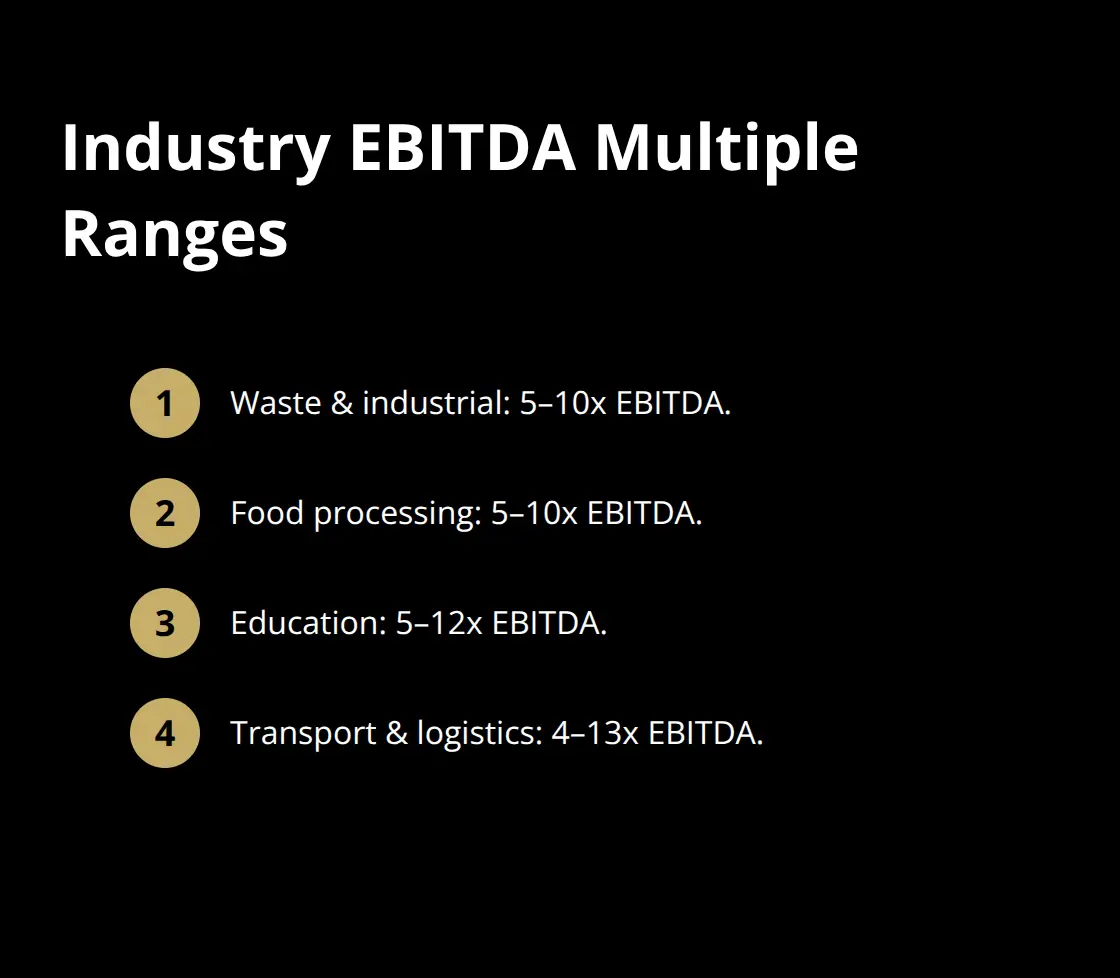
For owner-managed companies in the Baltic lower mid-market, EBITDA multiples in the low-to-mid single digits are the norm, with well-run, growing businesses in attractive sectors at the upper end and small, founder-dependent businesses at the lower end. Three things drive where a particular company lands.
Size. Larger companies attract larger multiples, partly because more buyers can afford them (including private equity and strategic acquirers from outside the region) and partly because size itself reduces risk — a company with forty staff survives the loss of one key person; a company with four may not.
Quality of earnings. Recurring contracts beat project work. A customer base where no single client is more than ten or fifteen percent of revenue beats one anchored to a single account. Three years of steady growth beats one exceptional year. Buyers pay for predictability, not for potential.
Dependence on the owner. This is the item Baltic sellers most often underestimate. If the owner holds the key customer relationships, signs off every quote and is the only person who understands the pricing spreadsheet, the buyer is not acquiring a business — they are acquiring a job with the risk that the value walks out the door on completion. Every step towards a company that runs without you is a step towards a higher multiple.
From enterprise value to what you receive
Multiplying normalised EBITDA by the agreed multiple gives enterprise value — the value of the operating business. The seller's proceeds are then adjusted for the balance sheet:
- Net debt is deducted: loans, leases, overdrafts and any deferred payments, less surplus cash.
- Working capital is compared to a normal level. If the business is sold with unusually low stock or unusually high creditors, the price comes down to compensate; if it is sold with more working capital than it needs, the seller is often paid for the excess.
- Non-operating assets — a property the business does not need, an investment portfolio, a holiday flat on the books — are dealt with separately, usually by taking them out before the sale.
It is common for a headline price to look generous and the cash on completion to look disappointing, purely because of these adjustments. Understanding them before negotiations start avoids that shock.
Deal structure changes the number
A price is only comparable to another price when the terms are the same. Sellers who accept part of the price as an earn-out — a payment contingent on the business hitting targets after completion — are usually offered a higher headline number, because the buyer is sharing risk with them. A seller who insists on all cash at completion should expect a lower one. The same is true of vendor financing, where the seller lends part of the price back to the buyer, and of rollover equity, where the seller keeps a minority stake. None of these is right or wrong; they are trades between certainty and price.
Baltic specifics worth knowing
A few things about the region shape how buyers think. All three countries are in the EU and the eurozone, so currency risk is not a factor and cross-border acquirers from the Nordics, Germany and Poland are active in the market — which supports pricing for companies with export revenue or a scalable model. Estonia's corporate income tax applies to distributed profit rather than to retained earnings, which affects how buyers model cash extraction and is one reason Estonian holding structures are common for regional groups. And because all three countries have transparent, digital company registries, buyers expect clean filings and will discount a company whose public accounts are late or inconsistent with what they are shown privately.
What the number is not
A valuation is not what you need for retirement, what you turned down five years ago, or what a listing portal in another country says a similar company is asking. It is an estimate of what a willing, informed buyer would pay today, and it becomes real only when one does. The most useful thing an owner can do a year or two before selling is to look at their own company the way a buyer would — normalised profit, quality of earnings, dependence on themselves — and fix what they can while there is still time.
Our free valuation tool gives an indicative range in a few minutes using the same logic. For a view on your specific company, talk to us.
This article is general guidance, not a valuation or financial advice. Every transaction depends on its own facts, and you should take professional advice before making decisions.